
Elevator Service Vehicle Graphics
Elevator service vehicle graphics should make the company recognizable while keeping service promises, manufacturer relationships and site access information under control. A compact repair van and a larger parts vehicle can share a clear identity without carrying the same detailed message. Start with the actual fleet roles and customer contact process, then define coverage around the real bodies, loading doors and equipment your team uses.
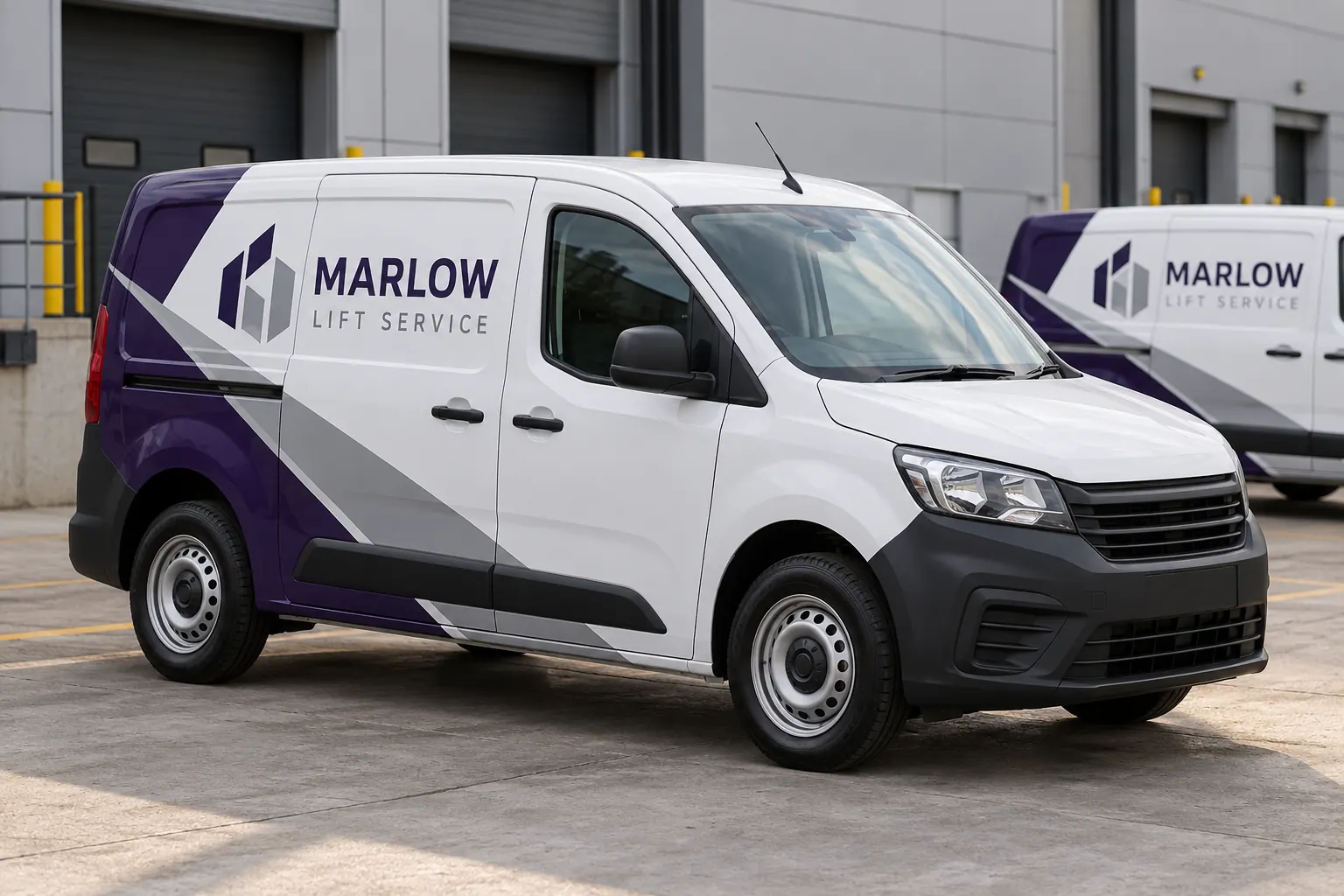
Original fictional commercial planning concept; not a completed customer installation.
Identify the service role represented by each van
Separate repair visits, planned maintenance support, installation work and parts transport according to your actual operation. Decide whether one concise descriptor accurately covers the fleet or whether controlled variants are needed. The vehicle should lead the right customer to the business, not attempt to reproduce a complete service agreement on the side panel.
Have the person responsible for customer inquiries confirm the wording. If the company uses terms such as emergency response or round-the-clock service, verify the exact public claim before artwork approval. A design should not create a service commitment by default. Keep response arrangements and detailed contractual terms in the business process that actually controls them.
Choose the public contact route deliberately
Decide whether the public message points to general service scheduling, a sales contact or another approved destination. If the business uses a separate existing-customer support route, clarify whether that belongs in public vehicle artwork. Confirm each number or address from one current source. Avoid mixing personal technician contacts with the company’s permanent fleet identity.
Review how the message works on both sides and the rear. A customer should be able to distinguish the company name and intended next action without reading several competing numbers. Where branches need different information, record the applicable units and retain separate approved versions. A shared folder should not make an outdated contact line appear current.
Keep access information outside the graphics package
Vehicle graphics do not replace appointment confirmation, building access arrangements or the identification process used by a facility. Keep keys, access codes, customer details and internal site instructions out of survey images and public artwork. The supplier needs relevant exterior information to assess the van, not the contents of a technician’s service records.
If a site-specific identifier is requested, have the business determine its purpose, permission and duration. Record who controls any later change. Avoid turning a temporary project reference into a permanent master design. The commercial identity should remain understandable when the van moves between buildings or when an individual service assignment ends.
Review manufacturer and affiliation wording before design release
Provide the exact approved assets and current permission for any manufacturer mark or relationship claim. An independent service company should not acquire an implied affiliation because a familiar product logo was added to fill an unused panel. Have the business contact who manages those relationships approve the complete proposed presentation before it reaches production.
Keep a record of the approved wording with the artwork reference. If a relationship changes, identify the affected vehicles and decide what needs updating. A later parts van should not inherit an obsolete claim from an old proof. The company name and an accurate service descriptor can provide a clear identity without unsupported badges or endorsements.
Survey loading doors, racks and body differences
Provide current photographs of both sides, front and rear, with close views of handles, tracks, windows and exterior accessories. Identify the exact body configuration and any planned fit-out changes. Explain the normal loading arrangement where it affects visibility or panel use. A compact service van and a high-roof parts carrier should not be treated as identical surfaces.
The fictional Marlow Lift Service concept demonstrates a restrained purple and silver identity across compact vans. It is a visual planning example, not a measured template or completed customer project. Use your own survey to establish the actual door divisions, equipment and condition. Ask the provider what additional information is required before dependent artwork is approved.
Compare coverage with future additions in view
Request defined lettering, partial or broader coverage options for the vehicles you actually operate. State the included sides and rear, quantities by body, artwork adaptations and any existing graphic removal. Ask how condition review and installation arrangements are handled. Compare those scope descriptions alongside the totals rather than choosing from a rendering alone.
If the fleet is likely to add another model, make that expectation visible without assuming the future vehicle is already included. Retain the approved identity and its current body versions. A later addition should begin with new photographs and a review of the actual configuration, even when the desired brand appearance is already well established.
Coordinate release around maintenance and callout commitments
Nominate the person who controls the service fleet and explain the actual release constraints. Identify whether another unit can cover scheduled work and which vehicles must remain available. Ask the graphics provider to assess the project arrangement before dates are confirmed. Avoid basing operational commitments on a general installation estimate from a different vehicle or project.
If several vans are involved, record the agreed sequence, handoff contact and unit reference for each. Keep artwork approval and vehicle readiness visible. When a substitute van is proposed, verify its body and approved version rather than assuming the shared color and logo make it interchangeable for the graphics work.
Prepare a usable inquiry and version record
Send the fleet list, current exterior photographs, approved identity, service descriptor, contact route and requested coverage. Include known surface issues, existing graphics and timing constraints. Identify manufacturer marks requiring permission and who can verify them. Keep sensitive site information out of the package, and mark unresolved decisions clearly.
For Pelican Wraps, explain whether the request concerns one compact van, several body types or a staged company refresh. Use the broader van and fleet pages for general program choices. Keep the elevator-service role, public contact policy and affiliation approvals explicit so the first discussion can produce a defined proposal and the next reorder can follow a controlled current version.
Frequently Asked Questions
Take the Next Step with a Clear Project Brief
Continue with the resource that matches your next decision:
Send the actual vehicle or surface photographs, quantities, approved brand files, requested coverage and timing constraints. Identify open questions so the project review can address your equipment and business needs.
