
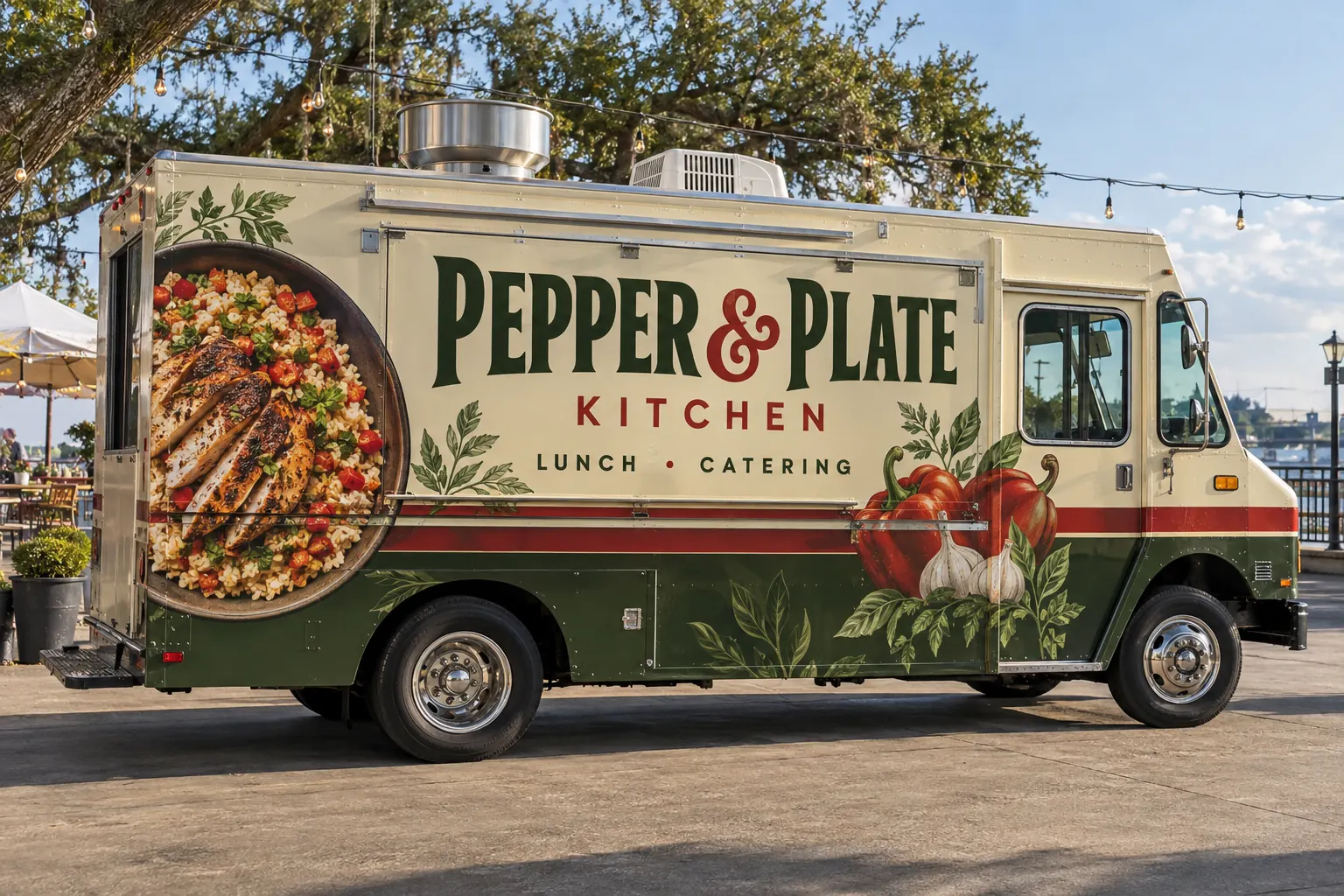
Illustrative commercial wrap design concept.
What to Know
Pelican Wraps • Commercial Graphics
Food Truck Wraps Built For Real-World Visibility
Food Truck Wraps from Pelican Wraps deliver menu-ready branding and memorable street presence for food trucks, concession trailers and mobile beverage units. We plan the message, coverage, materials, production and installation around how the asset is actually seen and used.
Strategy Before Production
Successful food truck wraps begin with the business objective rather than decoration. Pelican Wraps reviews the audience, operating area, viewing distance, brand standards, vehicle or surface condition, expected service life and future expansion plans. The result is a graphic system that communicates quickly without crowding every available panel.
Primary branding, the most valuable service message and a direct response path receive the strongest visual priority. Secondary details are organized so they remain useful without weakening recognition. This approach is especially important for food trucks, concession trailers and mobile beverage units, where motion, distance, door seams, hardware and changing light affect readability.
Design, Materials And Production
Artwork is prepared to the documented dimensions of the vehicle, equipment or architectural surface. We account for contours, windows, rivets, handles, panel breaks and areas that should remain free of important text. Clients review scaled proofs before production so placement, hierarchy and brand consistency can be confirmed.
Material selection depends on surface type, exposure, removability, finish and planned service life. Professional films, compatible inks and protective laminates are matched as a system. Production files, approved colors and placement references can be retained for repeat orders, damaged-panel replacements and fleet additions.
- Scaled artwork and placement review
- Commercial-grade films and laminates
- Color and production documentation
- Surface preparation and installation planning
- Repeatable files for future additions
- Final inspection and care guidance
Built Around Operations
Installation planning matters as much as design. Vehicles and working assets must be clean, dry and available long enough for proper preparation and application. Multi-unit programs can be phased to reduce operational disruption, while clearly labeled production packages help keep assignments organized.
For growing businesses, consistency becomes a management issue. New vehicle models may require adapted layouts, but the core identity, color, message priority and placement logic should remain recognizable. Pelican Wraps connects each project to broader fleet wrap planning, local service and replacement support.
Common Questions
Sell the Food Before the Decoration
A food truck or concession trailer graphic should help someone understand what is being served and where to order. Start with the business name and a clear food category. Decide whether the central attraction is barbecue, seafood, coffee, desserts or another defined offering. The artwork can express the brand's personality while keeping that information easy to read. A beautiful image is less useful if the customer cannot identify the food or ordering side.
Review the design in its serving configuration. A hatch that looks like a large available panel when closed may disappear during business hours. Menu boards, shade structures, condiment stations and payment areas change what people see. Show those items in the brief. The goal is a layout that works during service, when customers are choosing and ordering, as well as while the vehicle is traveling.
Keep Service Equipment in the Drawing
Photograph serving windows, access doors, vents, exhaust equipment, generators, storage compartments and utility connections. Identify the areas that open, become hot or require regular maintenance access. Their suitability and clearance must be reviewed for the specific application. A vehicle-wrap concept should not imply that graphics can cover any surface simply because it appears in a rendering.
Give the designer both a closed and open view of the serving side. Put persistent identity on panels that remain visible when hatches and doors are in use. Keep menu and price content manageable: details that change frequently may be better coordinated separately from long-term branding. Confirm where required operational or regulatory information must remain visible with the responsible business operator; a graphic proof is not a permit or compliance review.
Plan for a Menu That Can Change
Separate the lasting brand identity from seasonal items, prices and promotional messages. A food business may change its menu more often than it changes the truck graphics. Ask which elements can be updated without reworking the entire layout. Define any temporary panel or removable promotional area in the scope rather than assuming every part of a wrap can be replaced independently.
For more than one truck or trailer, keep the logo, core palette and food category consistent while recording the equipment-specific differences. A concession trailer and a self-propelled food truck need different drawings even when they share a brand. Keep the final proof, approved wording and serving-side orientation with each unit. This helps a future addition look related without copying a layout that ignores its hardware.
Prepare a Useful Food-Business Inquiry
Send the vehicle or trailer specifications, quantity, photographs of all sides and close views of the serving equipment. Include your approved logo, the food category, the desired brand tone and any deadline related to an opening or event. Be clear about what is already finalized and what still needs design work. A target date begins a scheduling discussion; it does not establish production availability.
The food-trailer visual on this page is a fictional design concept, included to show functional branding for a plausible local operator. It is not a completed Pelican customer job. Use it to discuss hierarchy, serving-side identity and coverage rather than to infer a project result. Begin through the quote form, then confirm the physical review and appointment arrangements for the Harvey shop.
Food Truck Wraps FAQs
Continue Planning
Related Solution→Wrap Cost Guide→Request A Quote→Commercial Graphics That Work
Build A Clear, Repeatable Brand System.
Get a Project-Specific Recommendation
Tell Pelican Wraps about your vehicles or commercial graphics project, the message you need to communicate and your timing. We can identify the details still needed for an accurate scope.
Related Planning Guide
Continue with Planning food trucks and enclosed trailers for additional questions to organize before the project review.
