
Septic Service Truck Graphics
Septic service truck graphics should help customers recognize your company and reach the right booking contact. Residential pumping inquiries, commercial account work and other approved service roles can need different public wording. This page focuses on that septic-service buying brief; use the broader tanker truck resource for body and surface planning. Keep operational information under its responsible fleet owner.
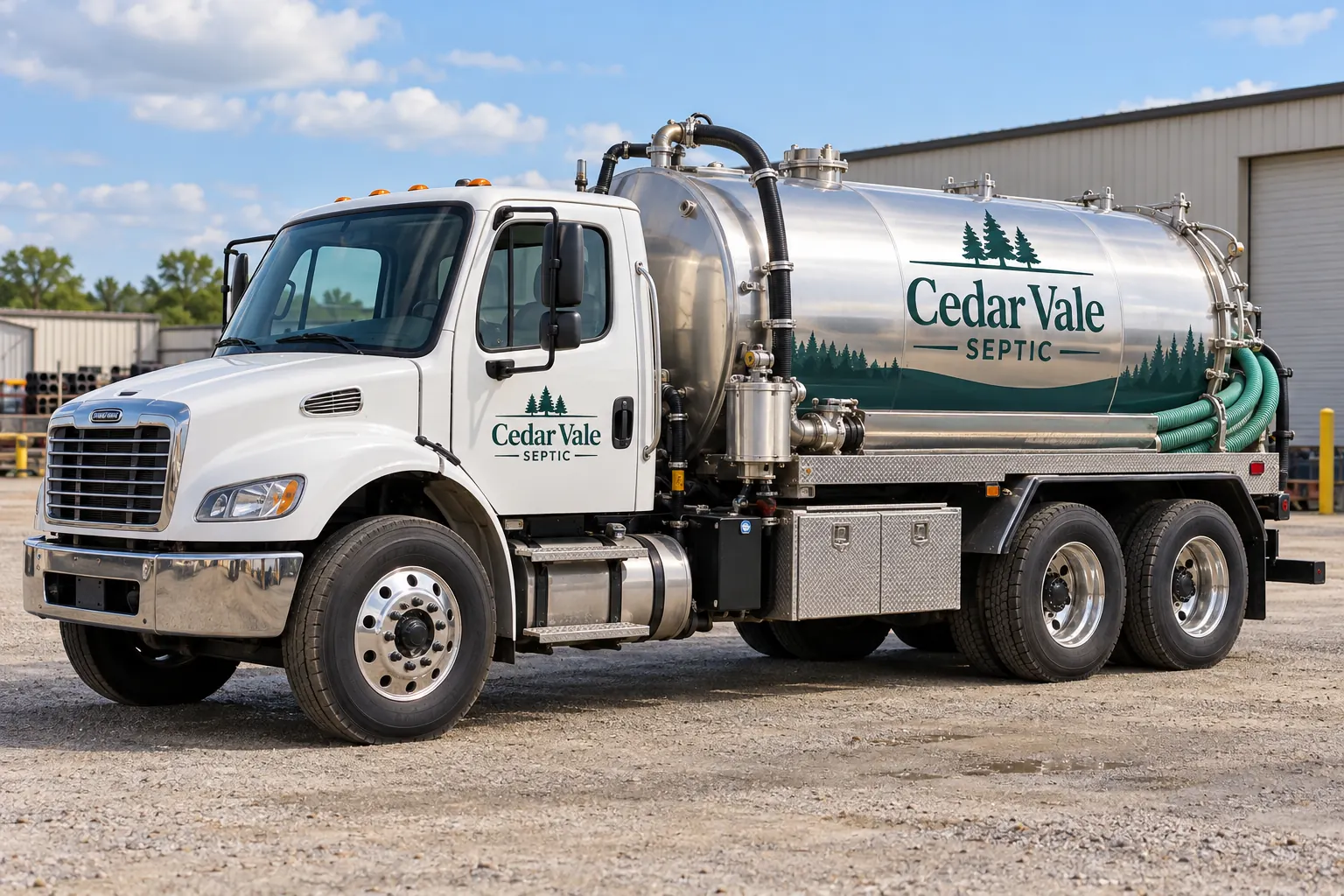
Original fictional commercial planning concept; not a completed customer installation.
Define the service message before choosing a tank design
Write down the work the company actually wants inquiries about. Pumping, maintenance and other service categories should follow the business’s approved wording and real capabilities. Choose a concise description that helps a customer recognize the service. A tank-side design does not need to carry every detail that belongs in a service proposal or booking conversation.
Confirm the customer contact route with the person who handles scheduling. If the business has different commercial and residential contacts, decide whether the vehicle needs one shared route or a controlled variation. Keep temporary driver information separate from the public identity. A clear message should lead to a useful next action without creating an unsupported availability promise.
Map residential and commercial inquiries before printing
Ask the team receiving calls which short service descriptor matches the actual business. A residential customer looking to arrange a visit may need a different contact route from a facility buyer discussing a commercial account. Decide whether one shared booking destination can handle both or whether the fleet has a deliberate approved variation. Do not print a temporary driver contact simply because that person currently handles a route.
Make a short message table in the project file: vehicle group, intended customer, approved service line, public contact source and content owner. For a fictional Cedar Vale Septic program, one group could use the general service descriptor while an account-support unit uses a separately approved line. The example is a method for organizing real business decisions, not evidence that a particular service, response commitment or route has been approved.
Map the message around hoses and working hardware
Identify which parts of the truck are routinely reached, opened or handled. Show how hoses are stored during travel and where the usual equipment sits. The designer needs to understand which areas remain visible and which are interrupted. Avoid planning a business name across a fitting or a location normally hidden by a hose assembly.
Discuss what the vehicle looks like in its ordinary parked configuration. The fictional Cedar Vale Septic concept shows a restrained cab identity and tank-side treatment, but it is not an equipment survey or an installation specification. Use the image to discuss hierarchy, then base the actual scope on photographs and assessment of your own truck.
Protect operational information during the graphics review
Ask the fleet’s responsible compliance or operations contact to identify markings and information that must remain visible and unchanged. Supply their current requirements and the relevant unit reference. Do not ask the graphics designer to guess which existing numbers, labels or markings can be covered, moved or recreated. Resolve those decisions before approving artwork placement.
Keep the commercial graphics proof and the operational marking review connected but distinct. A business name layout is not a regulatory assessment. If the brief includes replacement of any operational information, identify who supplies and verifies its exact content and placement. Avoid copying an old truck’s labels into a new design without confirming that they apply to the actual unit.
Compare cab lettering and tank coverage explicitly
A project may involve only the cab, a defined tank-side panel or a coordinated treatment across several areas. State the included surfaces in each option. Ask how artwork adaptation, existing graphic removal, condition assessment and installation arrangements are addressed. A large visual rendering can hide scope differences if the quote does not identify what work is actually included.
If the fleet contains several tank sizes or body configurations, list them separately. One price or proof should not silently represent all of them. Identify the quantity of each version and whether the same approved message applies. This lets the supplier evaluate the relevant adaptations instead of treating every unit as an identical blank cylinder.
Coordinate the graphics request with the booking team
Identify which units the dispatcher can release and who can confirm the actual availability. Keep customer appointment commitments outside the public artwork unless the business has deliberately approved a specific promise. Provide the graphics provider with real release constraints and ask for the proposed work arrangement to be assessed. The team receiving calls should know which unit group and contact version the project concerns.
If the business changes a service area, booking line or account assignment, identify affected vehicles before ordering additional graphics. Keep the public wording source separate from daily customer schedules. A truck can retain the same company identity while its dispatch assignment changes; the project record should show whether that change actually requires a new public message rather than assuming every route adjustment changes the artwork.
Use completion records to support later panel work
Retain the approved proof, the unit reference and photographs of the completed commercial graphics. Record the actual areas included in the job so a later replacement request can identify what changed. If fittings, hose storage or body equipment are modified, add new photographs before reusing the earlier layout.
For a damaged or changed area, provide factual photographs and the relevant artwork reference. Ask for the replacement scope to be reviewed rather than assuming a whole tank must be redone or that a small piece will necessarily match every surrounding condition. Keep observations separate from conclusions about cause, product performance or responsibility until the appropriate review has occurred.
Prepare a septic truck quote with the right evidence
Send the cab and tank details, current photographs, approved business files, exact service wording and requested coverage. Identify known surface issues, existing graphics and operational information that must be preserved. Include quantities by configuration and the contact responsible for release. Clearly mark questions about equipment, coatings or timing that still need an answer.
Use the broader truck and fleet resources for general program decisions. A Pelican Wraps inquiry can then focus on your actual septic service equipment and the commercial message you want assessed. A precise brief helps turn a first conversation into a defined proposal without assuming that a concept illustration, generic chassis template or old invoice describes the current vehicle.
Frequently Asked Questions
Take the Next Step with a Clear Project Brief
Continue with the resource that matches your next decision:
- Tanker Truck Wraps & Fleet Graphics
- Truck Wraps
- Fleet Wraps
- Commercial Vehicle Photo & Measurement Guide
- DOT Numbers, Unit Numbers & Commercial Vehicle Markings
- Request a Quote
- Industries
Send the actual vehicle or surface photographs, quantities, approved brand files, requested coverage and timing constraints. Identify open questions so the project review can address your equipment and business needs.
