
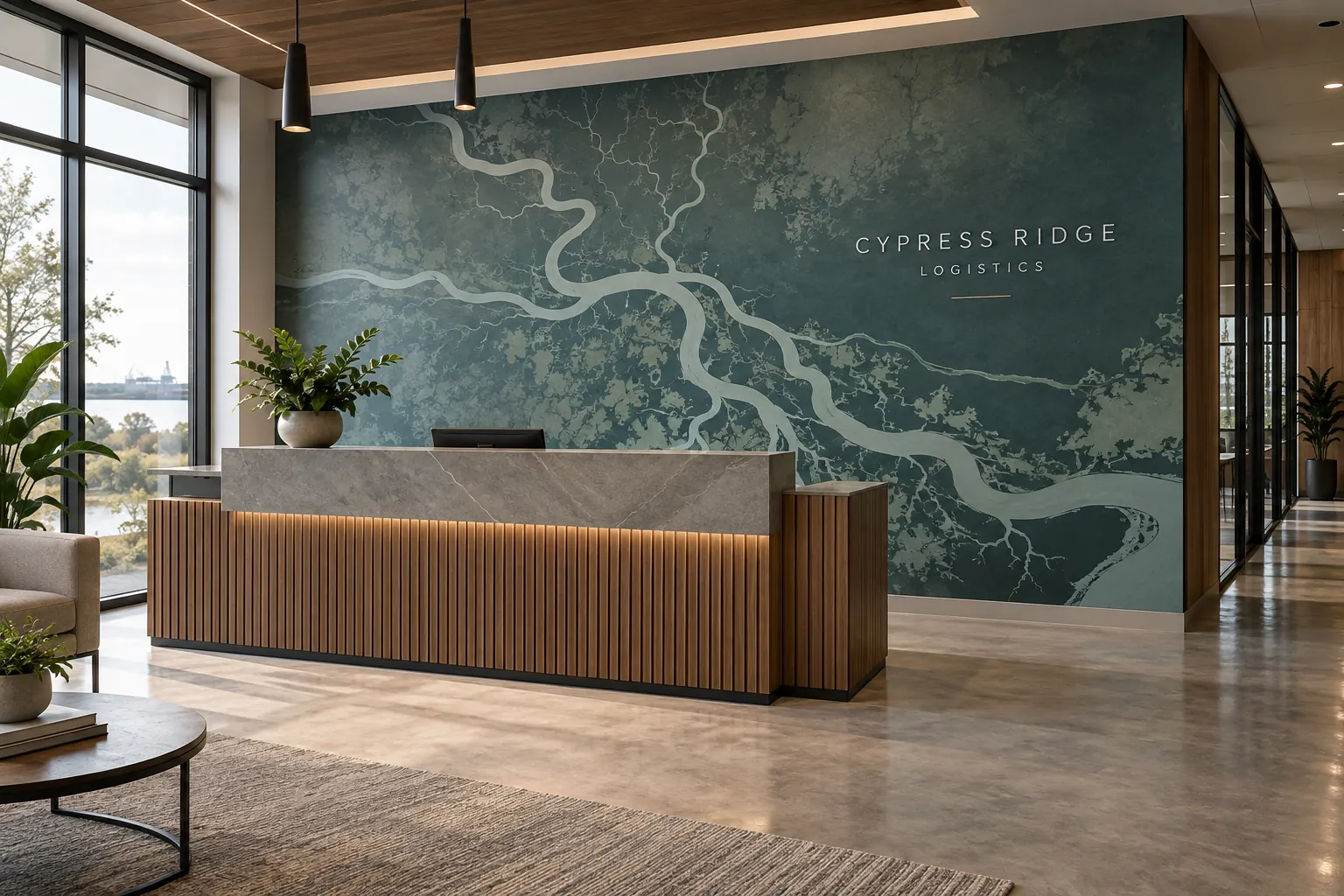
Fictional commercial graphics design concept; not a completed customer installation.
Choose a purpose that fits the room
A reception mural may introduce the business while a corridor graphic provides orientation or a sense of place. Decide which role matters before collecting visual references. A strong mural does not need to repeat the company contact details at poster size if a visitor is already inside the building. It needs a composition that belongs in that particular room.
Describe who uses the space and what should be understood or felt at the first viewing position. Note whether the mural will be seen from a doorway, across a counter or along a narrow passage. This information helps the designer place important content away from furniture and door openings and gives the approval team a practical reason for the proposed layout.
Document the wall as carefully as the artwork
Photograph the entire wall and then the texture, corners, repairs and obstructions. Identify the wall covering and paint system if records are available. Record recent painting, moisture concerns, loose areas or existing graphics for review rather than assuming every apparently smooth wall is ready for film.
Film selection and surface suitability depend on the actual wall and the relevant product guidance. The 3M wall, window and floor overview describes surface preparation and adhesion testing as part of application planning. Arrange the appropriate assessment for the proposed system; an attractive artwork proof cannot confirm that a particular painted wall will accept or release a graphic as expected.
Build the composition around real room geometry
Measure the proposed coverage and record ceiling changes, switches, outlets, doors and fixed furnishings. Mark objects that may move and those that will remain. Avoid putting a face, a word or the central logo where a cabinet, panel seam or door opening interrupts it. Review the wall both empty and in its normal furnished condition.
For a long mural, identify the parts that should read from a distance and the details intended for close viewing. Discuss panel arrangement and alignment before final production. A small digital image can conceal a low-resolution photograph or a composition problem that becomes obvious at room scale. Request the original artwork files and check their suitability at the intended finished size.
Use brand content that can remain accurate over time
Choose whether the mural should tell a durable brand story or support a short campaign. A room-sized display of a temporary offer may create avoidable replacement work after the promotion ends. Founding dates, location references, team names and service claims should be checked by someone who can verify them. Decorative content still needs appropriate rights and approval.
Use the same master logo and approved palette as the commercial fleet graphics, while allowing the interior composition to suit the room. Keep contact information or changeable operational details on a separate item when that makes future maintenance simpler. A shared visual identity can connect the property to the fleet without turning the wall into an enlarged van layout.
Plan access and occupancy before selecting a date
Identify the person who controls room access, furniture movement and business interruptions. Note reception hours, occupied offices and any site-specific work rules. If installation requires a clear wall, establish who removes and reinstates furniture, fixtures or displays. Those responsibilities should not be discovered when the installer arrives.
Record the target date and any dependencies, including wall repairs, painting, product-specific preparation requirements and artwork approval. Confirm readiness against the selected system rather than relying on a general waiting period for every coating. If the wall condition changes after the survey, provide updated photographs so the scope can be reviewed before production or installation proceeds.
Approve content, scale and panel planning separately
First check the words, logo, imagery and legal right to use the supplied material. Then review the composition on the wall dimensions, including obstructions and intended visible area. Finally, agree on relevant production details and how the installer will identify the approved version. These are connected checks with different purposes.
Use a dated approval record and name one person who can resolve conflicting comments. For several rooms, label every wall and proof with a consistent room reference. Do not approve a whole building from one attractive reception rendering. Each wall can have different measurements, finishes, lighting and installation access, even when the mural family uses the same creative theme.
Keep the mural serviceable after the space changes
Retain the finished dimensions, artwork, panel references, specified product information and installation photographs. Ask for care instructions appropriate to the installed system. Report edge movement, damage or wall problems promptly and describe the location with photographs rather than applying an unreviewed repair product.
When furniture, signage or the room function changes, check whether the mural still communicates clearly. Removal and replacement should be discussed against the actual wall and product; avoid assuming every adhesive film leaves every paint finish unchanged. For an initial plan, send the room photographs and mural brief. Related glass graphics can be reviewed as a separate surface within the same interior project.
Frequently Asked Questions
Turn Your Site Details Into a Clear Project Brief
Send current site photographs, an item schedule, logo files, dimensions and timing. Identify existing graphics and surface concerns so the project review can address the actual location.
Explore planning resources or request your business graphics quote.
