
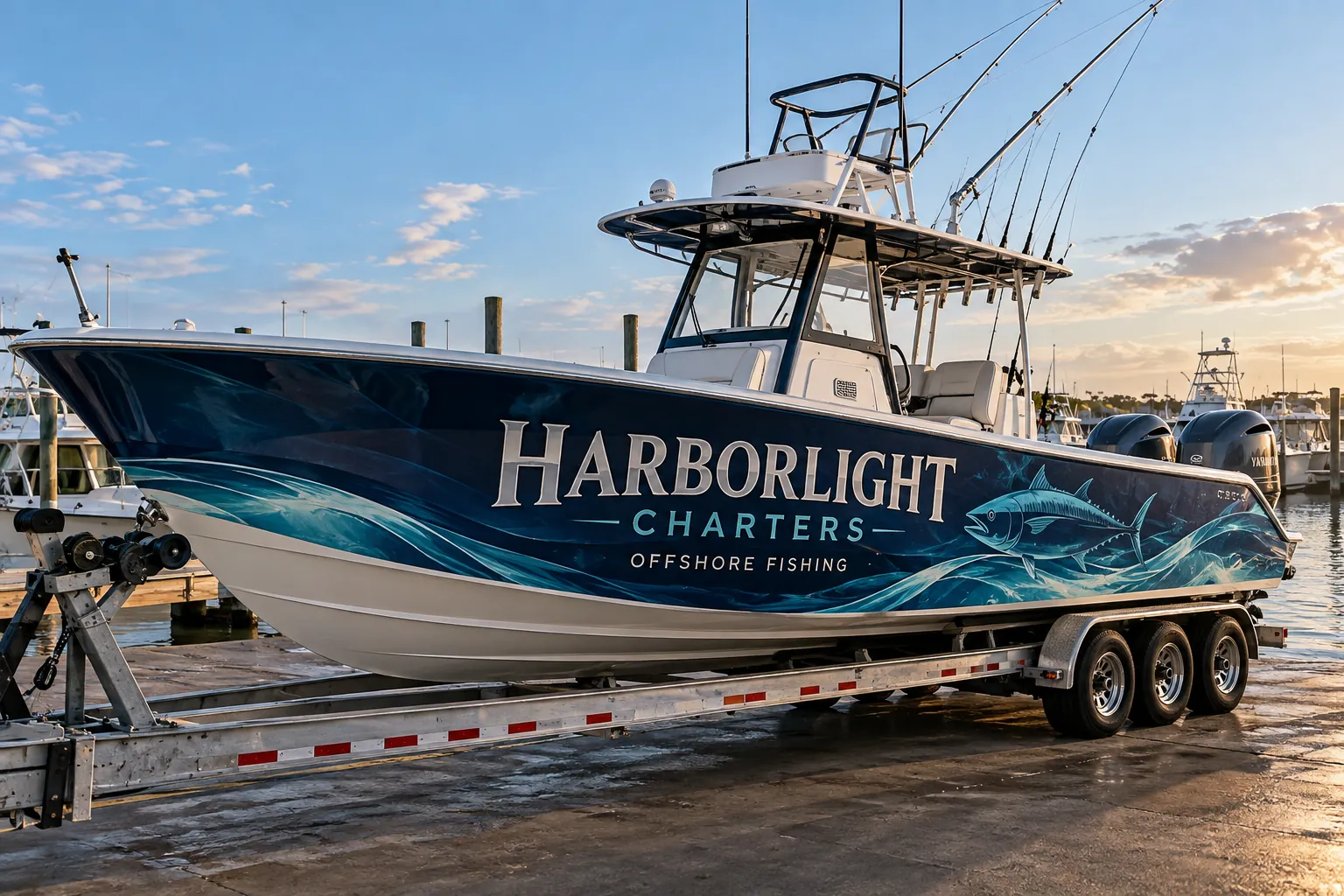
Illustrative commercial wrap design concept.
What to Know
Pelican Wraps • Commercial Graphics
Marine & Boat Wraps Built For Real-World Visibility
Marine & Boat Wraps from Pelican Wraps deliver waterfront branding and vessel identification for charter boats, workboats, marine-service fleets and promotional vessels. We plan the message, coverage, materials, production and installation around how the asset is actually seen and used.
Strategy Before Production
Successful commercial boat wraps begin with the business objective rather than decoration. Pelican Wraps reviews the audience, operating area, viewing distance, brand standards, vehicle or surface condition, expected service life and future expansion plans. The result is a graphic system that communicates quickly without crowding every available panel.
Primary branding, the most valuable service message and a direct response path receive the strongest visual priority. Secondary details are organized so they remain useful without weakening recognition. This approach is especially important for charter boats, workboats, marine-service fleets and promotional vessels, where motion, distance, door seams, hardware and changing light affect readability.
Design, Materials And Production
Artwork is prepared to the documented dimensions of the vehicle, equipment or architectural surface. We account for contours, windows, rivets, handles, panel breaks and areas that should remain free of important text. Clients review scaled proofs before production so placement, hierarchy and brand consistency can be confirmed.
Material selection depends on surface type, exposure, removability, finish and planned service life. Professional films, compatible inks and protective laminates are matched as a system. Production files, approved colors and placement references can be retained for repeat orders, damaged-panel replacements and fleet additions.
- Scaled artwork and placement review
- Commercial-grade films and laminates
- Color and production documentation
- Surface preparation and installation planning
- Repeatable files for future additions
- Final inspection and care guidance
Built Around Operations
Installation planning matters as much as design. Vehicles and working assets must be clean, dry and available long enough for proper preparation and application. Multi-unit programs can be phased to reduce operational disruption, while clearly labeled production packages help keep assignments organized.
For growing businesses, consistency becomes a management issue. New vehicle models may require adapted layouts, but the core identity, color, message priority and placement logic should remain recognizable. Pelican Wraps connects each project to broader fleet wrap planning, local service and replacement support.
Common Questions
Build the Charter Identity Around the Vessel
A commercial or charter boat needs an identity that works with the hull shape and the way customers encounter it. Start with the vessel or business name, the service offered and the essential contact route. A fishing charter, sightseeing operator and workboat may need different information. Place the message where it can be understood from the dock or a useful viewing distance instead of filling every available area with decorative detail.
Photograph both sides of the actual vessel and identify the intended coverage. Include rails, rubbing surfaces, fittings, drains, access points and equipment. A boat's curves and panel transitions matter to artwork placement, and the port and starboard sides may present different constraints. A concept should be adapted to the measured vessel rather than treated as a universal hull template.
Define the Marine Application Clearly
Identify the substrate and finish condition before choosing a graphics system. Paint, gelcoat, previous repairs and existing film need review. Explain the vessel's operating environment and how the proposed area encounters water, salt, abrasion and cleaning. Ask for the exact included surfaces and product suitability rather than assuming ordinary vehicle film can be used anywhere on a hull.
Watercraft graphics should be distinguished from an underwater coating or structural repair. The specified film's limits govern where it can be used; do not assume permanent submersion is acceptable. Discuss the waterline and the actual intended coverage with the project team. The final scope should identify exclusions and any preparation needed, with material and care instructions applicable to the installed system.
Make Dockside Recognition a Design Priority
Choose a visual hierarchy that gives the boat or operator a recognizable identity. Large lettering and a restrained palette can support that purpose without an unrelated mural competing for attention. Review the proof against the vessel's normal dock position, equipment and viewing angles. If a rail or fender frequently obscures an area, move important information rather than relying on an unobstructed rendering.
Keep required vessel information distinct and have the responsible operator confirm the applicable requirements. Sponsor marks, promotional details and booking information should be approved individually. For more than one vessel, preserve a shared brand system while adapting to each hull and equipment arrangement. Retain the approved proof and identify who can authorize a future name or contact change.
Coordinate Access Before Scheduling
A marine project needs a practical access plan as well as finished artwork. Explain where the vessel is kept, its dimensions, intended covered surfaces and when it can be made available. Do not assume that an online quote establishes marina access, haul-out arrangements or on-site installation. Those operational details must be confirmed for the project.
The charter-boat image on this page is a fictional illustrative concept, not a documented Pelican customer job. Use it to discuss commercial branding and layout, not to infer a warranty or completed installation. Send the vessel information and photographs through the inquiry form, identify any unknown finish or measurement details and confirm the review, access and scheduling arrangements before moving equipment or booking related services.
Marine & Boat Wraps FAQs
Continue Planning
Related Solution→Wrap Cost Guide→Request A Quote→Commercial Graphics That Work
Build A Clear, Repeatable Brand System.
Get a Project-Specific Recommendation
Tell Pelican Wraps about your vehicles or commercial graphics project, the message you need to communicate and your timing. We can identify the details still needed for an accurate scope.
Related Planning Guide
Continue with Charter boat branding for Gulf Coast operators for additional questions to organize before the project review.
