
DESIGNED. PRINTED. CUT. SHIPPED.
Custom DIY Wrap Kits & Trade Printing
We make the graphics. You choose the installer. Custom printed panels and cut graphics for personal vehicles, garage projects and wrap shops.
Personal vehicles · commercial fleets · installer-supplied production
START HERE
Who’s installing your graphics?
Pick the route that fits. We’ll help define the design, material and cut plan before production.
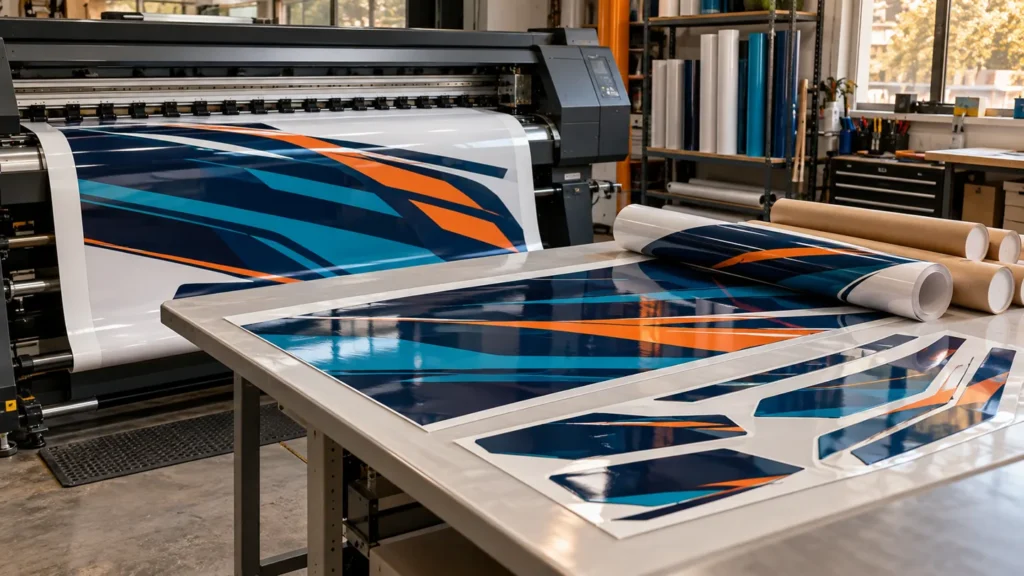
My team handles installation.
Keep the install in your shop and send the production work to Pelican. Request design support, print-ready file review, printed panels, contour cutting and delivery to your installer.
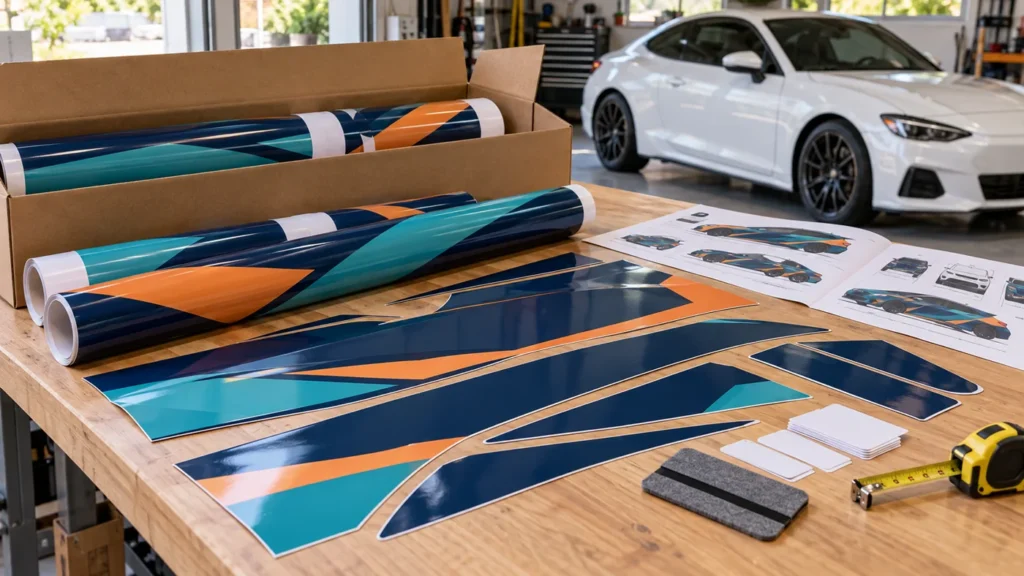
I’m doing the install.
Make your car, pickup, van or trailer your own. Get help with the design, or bring artwork you already have. We’ll review whether printed panels, cut graphics or a fitted kit suit the job.
A kit for your garage. A production partner for your shop.
You have the vehicle and an idea. We can help turn that idea into printed graphics you can receive and install where you are. Pelican Wraps designs, prints and cuts custom graphics for personal vehicles, working trucks, vans and enclosed trailers. Choose a shipped kit when you or your chosen installer will handle the application. Choose our installed service when you want the vehicle work handled at Pelican.
The starting point is a practical conversation about coverage. You might want a pair of door graphics, a hood accent, a coordinated side design or a larger printed wrap. A wrap company can bring its own approved artwork and ask us to review the print and cut production. There is no need to book an installation with us to send a production-only inquiry.
Choose the format that matches the job
Printed panel kits
provide the design across planned sheets or sections. The installer aligns the graphics, works around the vehicle’s shape and trims according to the approved installation plan. This format can make sense for larger vehicle graphics, box-truck sides or trailer panels where overlaps and the order of installation matter.
Contour-cut graphics and lettering
follow the approved outline of the design. Tell us whether you need separate decals, coordinated lettering or printed shapes. Transfer tape, weeding and grouping depend on the graphic and material, so they belong in the agreed production scope.
Model-specific cut kits
need an extra fit review. A vehicle outline on a screen is a design aid; it does not automatically prove where a real panel edge sits. Share the exact body style, trim, measurements and modifications. We confirm whether a suitable cut plan can be produced before calling the result a fitted kit.
Personal vehicle owners: build a manageable first project
Start by naming the result you want: a cleaner branded look, a custom graphic theme or an accent that ties the vehicle together. Then choose which panels matter most. A smaller design gives you a clear place to begin without treating a first garage project like a complete professional installation.
Tell us whether you have applied vinyl before and whether an experienced installer will help. Share photos of the working space if access could affect the plan. Large sheets need room to handle; complex curves and recesses need an approach suited to the selected film. We can review a more practical scope or help you prepare a brief for a local installer.
Our full versus partial wrap guide helps compare coverage. If the goal is a smaller name, number or service message, look at vehicle lettering and decals before deciding how much printed material you need.
Wrap companies: keep the installation with your team
If your shop has the installer and needs production support, choose Print for my shop. Send your business name, delivery city, vehicle schedule and a clear description of the work you want us to produce. Your designer can provide the layout, or you can request help adapting the graphics before printing.
For example, a shop in California can ask for a set of printed van panels to be delivered for its own installer. That request should identify the vehicle, quantity, panel map, color expectations, file scale and the person approving production. If several vehicles differ, list the variations rather than treating them as identical copies.
We agree on the material and laminate, print orientation, panel sequence, overlaps, trim allowances and cut paths as applicable. Include any packing or panel-label requirements in the brief. Trade pricing, delivery and any packaging or brand-presentation requests are confirmed in the proposal; they are not assumed by selecting the trade option.
From your idea to a box at your door
- Build the brief. Select a DIY kit or shop-print request in Wrap Studio. Choose the vehicle, coverage, additional surfaces and quantity. Add the year, model and preferred kit format. You can send the inquiry without a photo or an account.
- Review the actual fit. We check the vehicle information, measurements, artwork and installation plan. Photos should show both sides and the relevant front, rear, roof or hood surfaces. Note aftermarket parts, changed bumpers and anything that differs from a standard template.
- Approve the production plan. Review the design, spelling, coverage, dimensions and proposed material. Confirm the panel or cut layout, price, shipping and other itemized work. The sample preview in the app helps communicate direction; it is not the final production proof.
- Print, cut and prepare for shipment. Production follows the approved scope. Confirm the required panel identification, layout guide and packing details with us. Agree on the delivery recipient and schedule before arranging the installation.
What goes into the price?
Project minimum: $350. A shipped kit is quoted for its actual production requirements. Size and quantity matter, but so do artwork preparation, film choice, laminate, cut complexity and how the panels need to be organized. Shipping and applicable tax are confirmed for the delivery destination.
The app’s $12 flat-panel, $15 vehicle-panel and $20 sign square-foot figures are starting estimates for the existing service path. They do not automatically become DIY or trade production rates. The kit path shows a review request and planned area to support a written production quote for your specific order.
Ask the final proposal to separate design, printed material, cutting, accessories and delivery wherever applicable. If you are comparing suppliers, compare the same coverage and material specification, and confirm whether installation is included. A smaller number with different scope does not tell you what arrives in the box.
Send the details that prevent production surprises
Use the exact year, make, model, body length or wheelbase and relevant trim. Identify every surface you want covered, including the roof, hood, front wall, tailgate or rear doors. If you provide measurements, state what each measurement spans. A tape-measured width across a flat trailer side is different from a curved bumper measurement.
For artwork, keep the original design files available. Include your intended colors, readable contact details and any branding rules. Explain whether the graphic is mirrored, directional or different on each side. Do not rely on a low-resolution screenshot to establish a production-ready file. Our artwork guidelines and preflight checklist help organize the handoff.
Give the destination city, state, ZIP and country for shipping review. You do not need to place a full street address into a public design preview. The team can collect the confirmed delivery address with the proposal. Let us know who will install the kit and whether that person needs to review the layout before approval.
Prepare for installation and keep the project records
Inspect the vehicle before ordering. Peeling paint, rust, repairs, old adhesive and surface contamination may change whether a graphic can be applied successfully. A wrap should not be treated as a repair for an unsuitable substrate. Follow the instructions for the selected film and laminate rather than a generic temperature or cleaning rule copied from a different product.
For technical reference, review the manufacturer’s guidance such as 3M’s substrate preparation bulletin and Avery Dennison’s technical information. These resources do not imply a certification or warranty for a particular order; the quoted material system determines the relevant instructions.
When the kit arrives, inspect the packaging and compare its contents with the agreed list before application. Photograph any visible damage and contact the team with the project reference. Keep the approved proof, material details and panel map together. For later replacement work, those records are more useful than trying to reconstruct the original design from a vehicle photograph.
Prefer to leave installation to Pelican?
You can still use our full service path for box truck wraps, commercial van wraps and enclosed trailer graphics. The shipped-kit path exists for people and shops handling installation elsewhere. Tell us which route suits the project, and we will review the right scope from the start.
Professional production, with the right responsibilities.
PROFESSIONAL PRODUCTION · CLEAR HANDOFF
Good materials deserve a good install.
We select professional graphics materials and a print-and-cut process for the approved application. Your written scope identifies the material system, finish and cut or trim plan so the installer knows what is being supplied.
- Confirm the vehicle, dimensions, artwork and cut plan before release.
- Use the preparation and installation instructions for the specified products.
- Inspect the kit before applying it, and stop if something needs review.
Quality film, ink and cutting cannot correct a wrong measurement or an installation mistake. Review the responsibilities below before requesting a shipped order.
Print & shipped-kit responsibilities
Policy 2026-10-27.1 · Print-only and shipped-kit requests
Customer inputs and installer work need their own checks.
- You or your installer verify the measurements, vehicle details, supplied templates and approved artwork.
- Pelican produces the agreed graphics; installation is excluded unless the written quote expressly includes it.
- Customer sizing errors, approved-file errors and installation mistakes do not qualify for an automatic free reprint.
Customer sizing, approved-file and installation errors do not qualify for an automatic free remake. Pelican remains responsible for its own nonconforming work and obligations that cannot legally be waived.
Measurements, templates and vehicle fit
Where you or your installer supply or approve dimensions, units, scale, templates, cut paths or vehicle information, you are responsible for checking those inputs against the actual vehicle before production approval. Include body style, trim, accessories and modifications. A year/model selection or photograph does not establish measured fit. Pelican remains responsible for measurements it expressly agrees in writing to obtain itself. Do not release a job with unresolved sizing questions.
Artwork, spelling and proof approval
Check every approved proof for spelling, phone numbers, website addresses, colors, orientation, quantities, coverage, panel sequence, dimensions and cut/trim instructions. You must own or have permission to use the artwork and branding you supply. App previews and on-screen colors are planning aids; they are not scale drawings, physical color samples or production approval. We require a separate written production approval identifying the final proof and specification before making the custom order.
Professional materials and the agreed production system
Pelican selects professional graphics materials and a print-and-cut process for the agreed application. The written scope should identify the film, laminate where applicable, print/ink system, finish and cut or trim format. Quality materials do not correct an inaccurate template, unsuitable paint or an installation error. No single film, ink or cut method is suitable for every surface or exposure. Specific product performance, care instructions and any offered warranty must be confirmed for the actual order.
Your installer and the condition of the surface
For shipped kits and trade printing, you select and coordinate the installer. You or your installer handle inspection, preparation, positioning, trimming, application, finishing and aftercare according to the agreed material instructions. Disclose repairs, coatings, old adhesive, rust, peeling paint and nonstandard parts. Pelican is not responsible for damage or failure caused by customer or third-party measuring, preparation or installation errors, including damage from blades, heat, stretching, contamination or unsuitable surfaces. This does not excuse Pelican's own nonconforming work or legally nonwaivable responsibilities.
Customer errors, changes and replacement costs
If graphics match the approved production scope but need remaking because of customer-supplied or customer-approved sizing, artwork, quantity, fit information or an installation mistake, replacement design, printing, cutting, material, shipping and installer labor are the customer's responsibility. Replacement work receives a separate quote; a free remake is not automatic. Tell us about requested changes immediately. Changes or cancellations after written production release may require payment for authorized work and materials already committed, subject to the purchase agreement and applicable law.
Inspect the shipment and stop if something is wrong
Inspect the packaging, panel labels, quantities, printing and apparent fit before cutting or applying the graphics. If you see damage, a missing item, a production mismatch or a suspected defect, stop and contact Pelican promptly with the project reference and photos. Keep the packaging and affected material for review. Do not continue through a known problem or authorize extra third-party work without discussing a resolution. Later-discovered defects and rights provided by law are not erased by this inspection request.
Production concerns, material warranties and remedies
A suspected material defect or Pelican production error is reviewed against the approved scope and applicable product requirements; it is not automatically classified as installer error. Pelican will address nonconforming work and available remedies as required by the agreement and applicable law. Contact us before authorizing third-party removal, reinstallation, rush freight or other costs so the cause and remedy can be assessed. Manufacturer warranty coverage, if offered, follows its written conditions and does not automatically include installer labor or every incidental cost.
Trade-shop commitments and shipping arrangements
A shop ordering production remains responsible for its own measuring, customer promises, design approvals and installation commitments. Pelican does not adopt an outside shop's warranties, deadlines or labor obligations unless expressly agreed in writing. Confirm the delivery address, recipient, packing requirements and shipping charges before release. Production and delivery timing depend on the confirmed scope, approvals and carrier arrangements; do not commit an installer or vehicle downtime based only on an app estimate or an unconfirmed delivery date.
Custom-order scope and rights that remain
Custom printed or cut graphics are made for the approved order, rather than supplied as returnable stock for a change of mind or customer-input error. The written purchase agreement and applicable law govern any return, cancellation or remedy. This policy is not a blanket disclaimer of warranties or liability: it does not exclude liability for intentional or gross fault, physical injury, fraud, or any consumer, product-warranty or other right that cannot legally be waived. Any conflicting restriction applies only to the extent the law permits.
You will acknowledge these responsibilities when sending a print or kit request. Your final proof, measurements, production specification and purchase scope still need separate written approval before production.
DIY wrap kit questions
Let’s make something worth installing.
Start with your vehicle, coverage and design idea. Send a DIY or trade request and we will help define the production plan, fit and shipping before you commit.
